
NEWS & VIEWS
-
26 August 2026
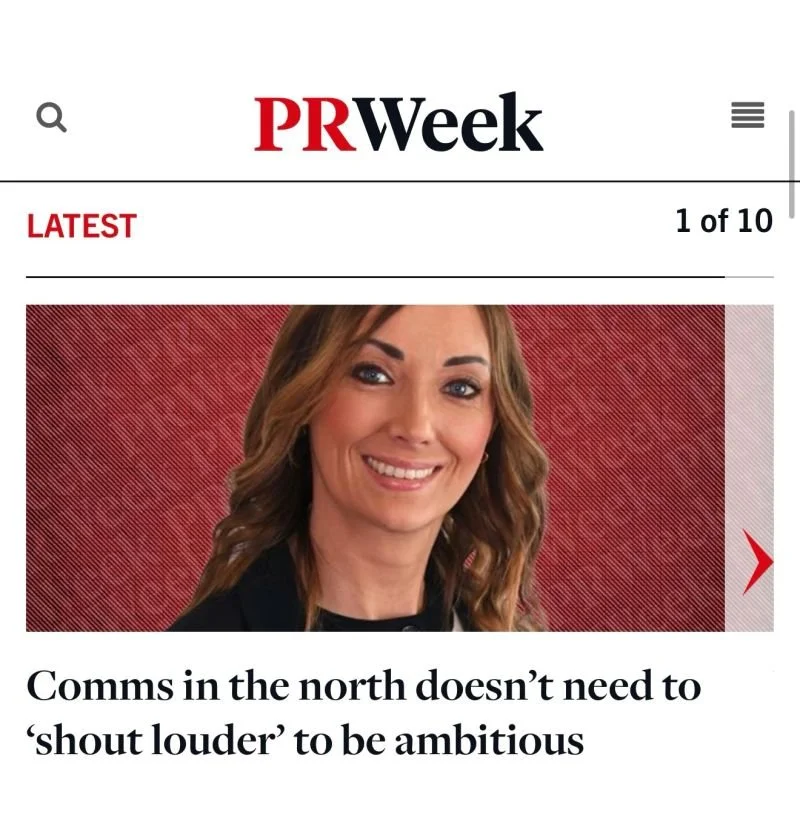
A recent piece on PRWeek suggested that communicators in the north need to shout louder to match the region’s ambitions and attract investment. It got me thinking.
Some of the most ambitious, successful and impactful pieces of work I’ve ever done will never be public, beyond a few small, carefully placed traces.
Click below to read more
-
26 August 2026
COMMS IN THE NORTH DOESN’T NEED TO ‘SHOUT LOUDER’ TO BE AMBITIOUS
A recent piece on PRWeek suggested that communicators in the north need to shout louder to match the region’s ambitions and attract investment. It got me thinking.
Some of the most ambitious, successful and impactful pieces of work I’ve ever done will never be public, beyond a few small, carefully placed traces.
Because exceptional corporate affairs – which is what we are talking about when we start probing investment – isn’t always about shouting the loudest.
It’s about knowing when to talk and when not to. It’s about building relationships, earning reputations and educating, often behind closed doors. It’s about a laser focus on commercial impact.
The north isn’t having a ‘heyday’. It hasn’t just sprung to life because we have a Prime Minister who genuinely cares about it. It’s never fixated on nor wished it were London.
It’s a region with clear identities that has been thriving and growing for years under various strategic growth plans, contributing billions to the UK economy, setting the blueprint for devolution and attracting inward investment that could’ve only been dreamed of 30 years ago.
Comms played its role in that. Sometimes it was loud. Sometimes it was quiet. Sometimes it was invisible.
We have plenty of that prowess in the north; many of us have built our entire careers here, shaped businesses and led work that has impacted communities, society and the economy.
Newsflash: comms people in the north aren’t mostly shuffling around thoughtless press releases ‘Bridget Jones-style’ while London cooks up the bigger stuff. The suggestion is insulting (and let’s not forget that a press office can be strategic and is an entirely valid scope of work for the right brief, whether it’s in London, Edinburgh or Leeds).
Communications in the north doesn’t have a volume problem or an issue with telling big stories. What it does have is a deep-rooted stereotypical challenge.
That we need London’s attention. That we’re second-best. That if we’d only speak up a bit, we’d be heard.
What makes us special as practitioners in the north is our quiet pragmatism.
“You want to be in the Daily Mail and on The One Show?” We’ve all been there.
“OK, why? You want to attract investment. Okayyyyyy…”
Does the north need to continue to use great strategic comms to attract investment from Westminster and beyond? Of course, like every region. Does that always come from shouting louder than everyone else? I’d say no.
Sure, sometimes that can be the right thing. But often stakeholders are more interested in a deliberately targeted, evidence-based campaign. Sadly, you’re unlikely to convince anyone about investment in the Daily Mail.
What on the surface may seem like a more modest ‘northern’ approach, when you scratch that surface, is lack of wastage; telling the best stories to the right audiences to show a genuine impact that matches ambition pound for pound. That can be some of the most rewarding work of all, even if only a handful of (the right) people know about it.
Byline: Katie Eborall, Founder of Eborland
https://www.prweek.co.uk/article/1968324/comms-north-doesnt-need-shout-louder-ambitious
Ends
-
August 2026
Sometimes the quietest actions yield the biggest results.
At Eborland, we love crisis planning. It's strategic, requires getting under the skin of every part of a business and helps set organisations up for long-term success.
We've never met a client who regretted investing in it.Click below to read more
-
August 2026
VALUE-BASED CRISIS PACKAGES DESIGNED TO DELIVER IMMEDIATE BUSINESS IMPACT
Sometimes the quietest actions yield the biggest results.
At Eborland, we love crisis planning. It's strategic, requires getting under the skin of every part of a business and helps set organisations up for long-term success.
We've never met a client who regretted investing in it.
But we recognise to many, it might not feel like a priority:The work is quiet / behind-the-scenes, meaning it's easy to deprioritise
It's often costly, which means it's invariably deprioritised
It's perceived as a 'nice-to-have' because 'it's unlikely to happen'
Then disaster strikes and you aren't prepared. Your people aren't prepared. Your stakeholders aren't prepared.
The ability to communicate quickly, in the right way, to the right people can make and break businesses. Even global brands get it wrong.
Everyone thinks it will never happen to them, that the plan they put in place five years ago will suffice, that if it does happen there will be enough time to figure it out.
None of these things are true and actually we live in times where there is more risk than ever from geopolitical factors, technologies and microaggressions in the workforce.
Suddenly that quiet work is preparing you for a cyber attack, a kink in the supply chain when a global conflict kicks off, a major incident on site.
The preparation that seemed so spenny a few months ago now looks like a drop in the ocean; not least because your business has lost trust and money as well as needing to pay on call crisis rates to solicitors, communicators, forensic accountants.
We all accept the quiet renewal of a TV licence, the Compare the Market comparison on car insurance and having a house alarm or Ring doorbell as good sense, protection, security. We never buy them expecting we're really going to get a knock on the door from a TV Licencing enforcement officer, that we are going to have an accident, or that we might be burgled.
We always know it's a possibility though, and that we need protection in case the worst happens.
For some reason we don't view something that could cause the exercising of Force Majeure on contracts overnight, the blemishing of reputations and the loss of Board confidence in the same way.
We need to start seeing crisis as an insurance policy and a continual investment in organisational health.
That's why, at Eborland Communications Ltd, we have developed a value proposition on our crisis planning and preparedness work.
We don't want to create expensive programmes that sell things you don't need - but we do want our clients to have a rubber-stamped, ISO-verified, robust approach that immediately delivers value, helping you plan for future years, and giving your people the tools not just for crisis, but to tackle any challenge strategically. Because we believe that brilliant crisis preparedness creates an immediate step-change.
The quietest work can have biggest impact, not just when the proverbial hits the fan, but when you have a prepared, engaged team ready for whatever challenges are thrown at them.To find out more, email hello@eborland.com
Ends

-
20 April 2026
Ex-Grayling Board Director, Katie Eborall, has today launched Eborland Communications, a new agency specialising in work focused on leaving a positive and long-lasting impact on people.
Offering a range of integrated PR and comms services, Eborland will deliver strategic advisory and campaigns spanning Reputation, Crisis, Stakeholder, Community and Brand Engagement.
Click below to read more
-
20 April 2026
Ex-Grayling Board Director, Katie Eborall, has today launched Eborland Communications, a new agency specialising in work focused on leaving a positive and long-lasting impact on people.
Offering a range of integrated PR and comms services, Eborland will deliver strategic advisory and campaigns spanning Reputation, Crisis, Stakeholder, Community and Brand Engagement.
Eborall departed Grayling at the end of 2025 after a 14-year tenure, most recently as UK Board Director and Head of North, where she led clients such as M&S, Greene King, Nestle, First Bus, Leeds Bradford Airport, The Co-op Group, Cummins, Ardent Management and YO! on accounts spanning Retail, Transport, Built Environment, Hospitality, and Engineering and Manufacturing. Previously she held roles with Hatch Communications and Ptarmigan in Leeds.
Eborland launches with a number of clients, including start up social infrastructure and energy provider Infracare, and aims to help clients focus on creating a personalised, human-first approach to communications, while building an agency with a strategy cemented in long-term people commitment.
Eborall said: “We are in the business of people and all audiences, colleagues and clients are human first and foremost. I want to create something that brings that single-minded empathy to the forefront, to reach audiences on a level everyone can relate to, to do work that makes a difference to everyday lives and the world around us and that leaves a lasting imprint.
“Whether that’s essential transport that helps people to connect with opportunity, infrastructure that transforms places, revitalising high streets or energy that helps us to live more sustainably, there’s a human at either end of every interaction, and we serve to influence and enhance reputations person-by-person. Eborland exists to help clients never lose sight of the mission they have set out to deliver against, to hold themselves accountable to that through comms, and to use their relatability to tell their stories with impact, fairness and sincerity.”
Though at its basic level the agency name stems from Eborall’s own name, there is a bigger meaning behind the brand.
“Ebor comes from the old English word for yew tree, known for being long lasting and indestructible, while Land is a space where we act as grounded counsel for clients. Together, Eborland is an agency that believes consultancy can be a safe space for people to thrive, progress and be truly individual, while delivering work that has long term impact. This is the shared perspective we look for in our clients, so that we can leave a lasting imprint together.”
Eborall believes her integrated background supports the agency’s proposition: “Being able to look at the full consumer, reputational, political and societal picture is both efficient for clients in a challenging and disruptive market, and advantageous in helping complex businesses solve their challenges.”
Eborall is a known industry advocate for DEI. She has been Chair of PRCA Yorkshire & Lincolnshire since 2020, Membership Officer for Women in PR since 2024 and recently joined the Steering Committee for Break the Silence. She has a long-standing track record of mentoring with organisations such as Leeds Beckett University. In her role at Grayling, she was a founding member of the agency’s original DEI group and Parenting Employee Resource Group, and she was responsible at Board level for activating a range of inclusivity programmes, including with partners such as Lexxic, Creative Mentor Network and Creative Access.
She said: “I feel privileged to have the opportunity to start something from the ground up where psychological safety and individuality are at the core of the business. I’m from a working-class background and you don’t have to look far to find my views on supporting women and the barriers that exist in the industry – I’m pretty open with my views about driving change!
“Starting up my own agency not only fulfils a personal ambition, but also gives me a bigger platform to make a true imprint on the sector to become more equitable. True to the brand, Eborland will champion and lead on DEI issues in the industry, and we are already working on some exciting initiatives for H2 and into 2027, which will benefit the whole sector.”
Eborall will initially work with a range of partners on owned client projects and retainers, recruiting her own team as the consultancy grows.
To find out more about Eborland, visit www.eborland.com
Ends